> ## Documentation Index
> Fetch the complete documentation index at: https://docs-staging-docs-event-stream-action-templates.mintlify.site/llms.txt
> Use this file to discover all available pages before exploring further.
# Code Samples for Common Tenant Access Control List Use Cases
> Implement common use cases for the Tenant ACL with these code samples for Management API requests, Auth0 SDKs and CLIs, and the Auth0 Terraform provider.
## Block a request
This Tenant ACL rule example blocks incoming traffic from a specific geolocation country code.
To create this Tenant ACL rule with the Management API:
1. [Get a Management API access token](/docs/secure/tokens/access-tokens/management-api-access-tokens/get-management-api-access-tokens-for-production) with the `create:network_acls` scope.
2. Call the Management API [Create access control list endpoint](https://auth0.com/docs/api/management/v2/network-acls/post-network-acls) with the following body:
```json expandable theme={null}
{
"description": "Example of blocking a request",
"active": true,
"priority": 2,
"rule": {
"action": {
"block": true
},
"match": {
"geo_country_codes": [
"{geoCountryCode}"
]
},
"scope": "authentication"
}
}{
"description": "Example of blocking a request",
"active": true,
"priority": 2,
"rule": {
"action": {
"block": true
},
"match": {
"geo_country_codes": [
"{geoCountryCode}"
]
},
"scope": "authentication"
}
}
```
```go expandable theme={null}
package main
import (
"context"
"log"
"github.com/auth0/go-auth0"
"github.com/auth0/go-auth0/management"
)
func main() {
mgmt, err := management.New("{yourDomain}", management.WithClientCredentials("{yourClientId}", "{yourClientSecret}"))
if err != nil {
log.Fatal(err)
}
networkACL := &management.NetworkACL{
Description: auth0.String("Example of blocking a request"),
Active: auth0.Bool(true),
Priority: auth0.Int(2),
Rule: &management.NetworkACLRule{
Action: &management.NetworkACLRuleAction{
Block: auth0.Bool(true),
},
Match: &management.NetworkACLRuleMatch{
GeoCountryCodes: &[]string{"{geoCountryCode}"},
},
Scope: auth0.String("authentication"),
},
}
err = mgmt.NetworkACL.Create(context.Background(), networkACL)
if err != nil {
log.Fatal(err)
}
log.Println("Network ACL has been created")
}
```
```js theme={null}
const createNetworkAclPayload: Management.CreateNetworkAclRequestContent = {
description: "Example of blocking a request",
active: true,
priority: 2,
rule: {
action: {
block: true,
},
match: {
geo_country_codes: ["{geoCountryCode}"],
},
scope: "authentication",
},
};
const createNetworkAcl = await client.networkAcls.create(createNetworkAclPayload);
```
```terraform theme={null}
resource "auth0_network_acl" "example_blocking_request_acl" {
description = "Example of blocking a request"
active = true
priority = 2
rule {
action {
block = true
}
match {
geo_country_codes = ["{geoCountryCode}"]
}
scope = "authentication"
}
}
```
```yaml theme={null}
networkACLs:
- description: Example of blocking a request
active: true
priority: 2
rule:
action:
block: true
match:
geo_country_codes:
- {geoCountryCode}
scope: authentication
```
```bash wrap theme={null}
auth0 network-acl create \
--description "Example of blocking a request" \
--active true \
--priority 2 \
--rule '{"action":{"block":true},"match":{"geo_country_codes":["{geoCountryCode}"]},"scope":"authentication"}'
```
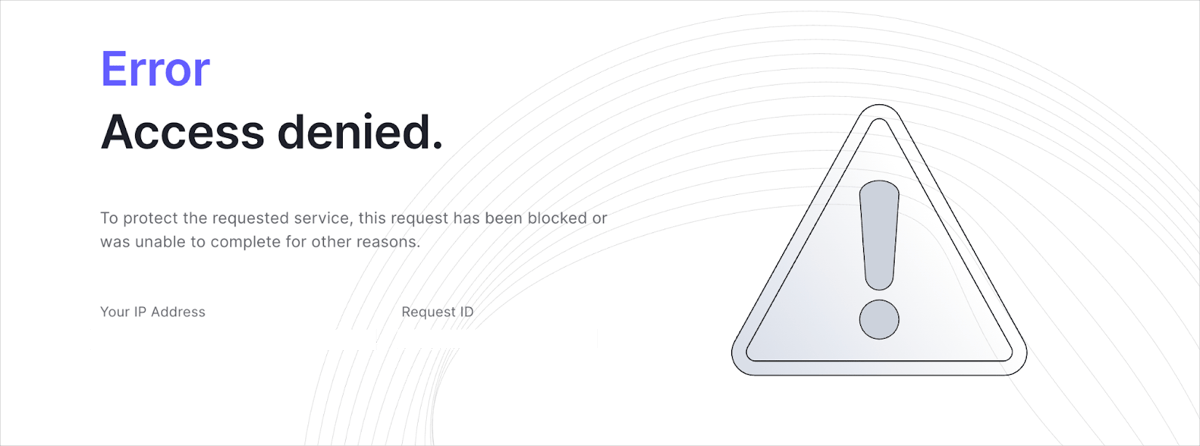
This is an example of a block page:
 ## Allow a request
This Tenant ACL rule example allows traffic only from a specific geolocation country code.
To create this Tenant ACL rule with the Management API:
1. [Get a Management API access token](/docs/secure/tokens/access-tokens/management-api-access-tokens/get-management-api-access-tokens-for-production) with the `create:network_acls` scope.
2. Call the Management API [Create access control list endpoint](https://auth0.com/docs/api/management/v2/network-acls/post-network-acls) with the following body:
```json theme={null}
{
"description": "Example of allowing a request",
"active": true,
"priority": 2,
"rule": {
"action": {
"allow": true
},
"match": {
"geo_country_codes": [
"{geoCountryCode}"
]
},
"scope": "authentication"
}
}
```
```go expandable theme={null}
package main
import (
"context"
"log"
"github.com/auth0/go-auth0"
"github.com/auth0/go-auth0/management"
)
func main() {
mgmt, err := management.New("{yourDomain}", management.WithClientCredentials("{yourClientId}", "{yourClientSecret}"))
if err != nil {
log.Fatal(err)
}
networkACL := &management.NetworkACL{
Description: auth0.String("Example of allowing a request"),
Active: auth0.Bool(true),
Priority: auth0.Int(2),
Rule: &management.NetworkACLRule{
Action: &management.NetworkACLRuleAction{
Allow: auth0.Bool(true),
},
Match: &management.NetworkACLRuleMatch{
GeoCountryCodes: &[]string{"{geoCountryCode}"},
},
Scope: auth0.String("authentication"),
},
}
err = mgmt.NetworkACL.Create(context.Background(), networkACL)
if err != nil {
log.Fatal(err)
}
log.Println("Network ACL has been created")
}
```
```js theme={null}
const createNetworkAclPayload: Management.CreateNetworkAclRequestContent = {
description: "Example of allowing a request",
active: true,
priority: 2,
rule: {
action: {
allow: true,
},
match: {
geo_country_codes: ["{geoCountryCode}"],
},
scope: "authentication",
},
};
const createNetworkAcl = await client.networkAcls.create(createNetworkAclPayload);
```
```terraform theme={null}
resource "auth0_network_acl" "example_allowing_request_acl" {
description = "Example of allowing a request"
active = true
priority = 2
rule {
action {
allow = true
}
match {
geo_country_codes = ["{geoCountryCode}"]
}
scope = "authentication"
}
}
```
```yaml theme={null}
networkACLs:
- description: Example of allowing a request
active: true
priority: 2
rule:
action:
allow: true
match:
geo_country_codes:
- {geoCountryCode}
scope: authentication
```
```bash wrap theme={null}
auth0 network-acl create \
--description "Example of allowing a request" \
--active true \
--priority 2 \
--rule '{"action":{"allow":true},"match":{"geo_country_codes":["{geoCountryCode}"]},"scope":"authentication"}'
```
## Redirect a request
This Tenant ACL rule example redirects all traffic from a specific geolocation country code.
To create this Tenant ACL rule with the Management API:
1. [Get a Management API access token](/docs/secure/tokens/access-tokens/management-api-access-tokens/get-management-api-access-tokens-for-production) with the `create:network_acls` scope.
2. Call the Management API [Create access control list endpoint](https://auth0.com/docs/api/management/v2/network-acls/post-network-acls) with the following body:
```json theme={null}
{
"description": "Example of redirecting a request",
"active": true,
"priority": 2,
"rule": {
"action": {
"redirect": true,
"redirect_uri": "REDIRECT_URI"
},
"match": {
"geo_country_codes": [
"{geoCountryCode}"
]
},
"scope": "authentication"
}
}
```
```go expandable theme={null}
package main
import (
"context"
"log"
"github.com/auth0/go-auth0"
"github.com/auth0/go-auth0/management"
)
func main() {
mgmt, err := management.New("{yourDomain}", management.WithClientCredentials("{yourClientId}", "{yourClientSecret}"))
if err != nil {
log.Fatal(err)
}
networkACL := &management.NetworkACL{
Description: auth0.String("Example of redirecting a request"),
Active: auth0.Bool(true),
Priority: auth0.Int(2),
Rule: &management.NetworkACLRule{
Action: &management.NetworkACLRuleAction{
Redirect: auth0.Bool(true),
RedirectURI: auth0.String("REDIRECT_URI"),
},
Match: &management.NetworkACLRuleMatch{
GeoCountryCodes: &[]string{"{geoCountryCode}"},
},
Scope: auth0.String("authentication"),
},
}
err = mgmt.NetworkACL.Create(context.Background(), networkACL)
if err != nil {
log.Fatal(err)
}
log.Println("Network ACL has been created")
}
```
```js theme={null}
const createNetworkAclPayload: Management.CreateNetworkAclRequestContent = {
description: "Example of a complex comparison",
active: true,
priority: 1,
rule: {
action: {
block: true,
},
match: {
geo_country_codes: ["{geoCountryCode}"],
},
not_match: {
geo_subdivision_codes: ["{geoSubdivisionCode}"],
},
scope: "authentication",
},
};
const createNetworkAcl = await client.networkAcls.create(createNetworkAclPayload);
```
```terraform theme={null}
resource "auth0_network_acl" "example_complex_comparison_acl" {
description = "Example of a complex comparison"
active = true
priority = 1
rule {
action {
block = true
}
match {
geo_country_codes = ["{geoCountryCode}"]
}
not_match {
geo_subdivision_codes = ["{geoSubdivisionCode}"]
}
scope = "authentication"
}
}
```
```yaml theme={null}
networkACLs:
- description: Example of a complex comparison
active: true
priority: 1
rule:
action:
block: true
match:
geo_country_codes:
- {geoCountryCode}
not_match:
geo_subdivision_codes:
- {geoSubdivisionCode}
scope: authentication
```
```bash wrap theme={null}
auth0 network-acl create \
--description "Example of a complex comparison"
--active true \
--priority 1 \
--rule '{"action":{"block":true},"match":{"geo_country_codes":["{geoCountryCode}"]},"not_match":{"geo_subdivision_codes":["{geoSubdivisionCode}"]},"scope":"authentication"}'
```
## Complex comparisons
You can combine the `match` and `not_match` operators in a single Tenant ACL rule to enforce fine-grained access policies.
This Tenant ACL rule example evaluates the `geo_country_code` and `geo_subdivision_code` signals to block all traffic from a given country except for a specific state, region, or province within that country.
To create this Tenant ACL rule with the Management API:
1. [Get a Management API access token](/docs/secure/tokens/access-tokens/management-api-access-tokens/get-management-api-access-tokens-for-production) with the `create:network_acls` scope.
2. Call the Management API [Create access control list endpoint](https://auth0.com/docs/api/management/v2/network-acls/post-network-acls) with the following body:
```json theme={null}
{
"description": "Example of a complex comparison",
"active": true,
"priority": 1,
"rule": {
"action": {
"block": true
},
"match": {
"geo_country_codes": [
"{geoCountryCode}"
]
},
"not_match": {
"geo_subdivision_codes": [
"{geoSubdivisionCode}"
]
},
"scope": "authentication"
}
}
```
```go expandable theme={null}
package main
import (
"context"
"log"
"github.com/auth0/go-auth0"
"github.com/auth0/go-auth0/management"
)
func main() {
mgmt, err := management.New("{yourDomain}", management.WithClientCredentials("{yourClientId}", "{yourClientSecret}"))
if err != nil {
log.Fatal(err)
}
networkACL := &management.NetworkACL{
Description: auth0.String("Example of a complex comparison"),
Active: auth0.Bool(true),
Priority: auth0.Int(1),
Rule: &management.NetworkACLRule{
Action: &management.NetworkACLRuleAction{
Block: auth0.Bool(true),
},
Match: &management.NetworkACLRuleMatch{
GeoCountryCodes: &[]string{"{geoCountryCode}"},
},
NotMatch: &management.NetworkACLRuleMatch{
GeoSubdivisionCodes: &[]string{"{geoSubdivisionCode}"},
},
Scope: auth0.String("authentication"),
},
}
err = mgmt.NetworkACL.Create(context.Background(), networkACL)
if err != nil {
log.Fatal(err)
}
log.Println("Network ACL has been created")
}
```
```js theme={null}
const createNetworkAclPayload: Management.CreateNetworkAclRequestContent = {
description: "Example of a complex comparison",
active: true,
priority: 1,
rule: {
action: {
block: true,
},
match: {
geo_country_codes: ["{geoCountryCode}"],
},
not_match: {
geo_subdivision_codes: ["{geoSubdivisionCode}"],
},
scope: "authentication",
},
};
const createNetworkAcl = await client.networkAcls.create(createNetworkAclPayload);
```
```terraform theme={null}
resource "auth0_network_acl" "example_complex_comparison_acl" {
description = "Example of a complex comparison"
active = true
priority = 1
rule {
action {
block = true
}
match {
geo_country_codes = ["{geoCountryCode}"]
}
not_match {
geo_subdivision_codes = ["{geoSubdivisionCode}"]
}
scope = "authentication"
}
}
```
```yaml theme={null}
networkACLs:
- description: Example of a complex comparison
active: true
priority: 1
rule:
action:
block: true
match:
geo_country_codes:
- {geoCountryCode}
not_match:
geo_subdivision_codes:
- {geoSubdivisionCode}
scope: authentication
```
```bash wrap theme={null}
auth0 network-acl create \
--description "Example of a complex comparison" \
--active true \
--priority 1 \
--rule '{"action":{"block":true},"match":{"geo_country_codes":["{geoCountryCode}"]},"not_match":{"geo_subdivision_codes":["{geoSubdivisionCode}"]},"scope":"authentication"}'
```
## Enforce traffic through specific infrastructure
You can combine the `hostnames` and `connecting_ipv4_cidrs` signals to route requests to your tenant exclusively through your authorized infrastructure, such as a reverse proxy or VPN.
This Tenant ACL rule example blocks access to your canonical and custom domains unless the request originates from a specific set of IP addresses that connect directly to the Auth0 edge. This prevents users from bypassing your security controls by accessing your tenant hostnames directly from the public internet.
To create this Tenant ACL rule with the Management API:
1. [Get a Management API access token](/docs/secure/tokens/access-tokens/management-api-access-tokens/get-management-api-access-tokens-for-production) with the `create:network_acls` scope.
2. Call the Management API [Create access control list endpoint](https://auth0.com/docs/api/management/v2/network-acls/post-network-acls) with the following body:
```json theme={null}
{
"description": "Restrict access to specific proxy IPs for custom and canonical domains",
"active": true,
"priority": 10,
"rule": {
"action": {
"block": true
},
"match": {
"hostnames": ["auth.example.com", "my-tenant.us.auth0.com"]
},
"not_match": {
"connecting_ipv4_cidrs": [
"192.0.2.0/24",
"203.0.113.5/32"
]
},
"scope": "tenant"
}
}
```
## Allow a request
This Tenant ACL rule example allows traffic only from a specific geolocation country code.
To create this Tenant ACL rule with the Management API:
1. [Get a Management API access token](/docs/secure/tokens/access-tokens/management-api-access-tokens/get-management-api-access-tokens-for-production) with the `create:network_acls` scope.
2. Call the Management API [Create access control list endpoint](https://auth0.com/docs/api/management/v2/network-acls/post-network-acls) with the following body:
```json theme={null}
{
"description": "Example of allowing a request",
"active": true,
"priority": 2,
"rule": {
"action": {
"allow": true
},
"match": {
"geo_country_codes": [
"{geoCountryCode}"
]
},
"scope": "authentication"
}
}
```
```go expandable theme={null}
package main
import (
"context"
"log"
"github.com/auth0/go-auth0"
"github.com/auth0/go-auth0/management"
)
func main() {
mgmt, err := management.New("{yourDomain}", management.WithClientCredentials("{yourClientId}", "{yourClientSecret}"))
if err != nil {
log.Fatal(err)
}
networkACL := &management.NetworkACL{
Description: auth0.String("Example of allowing a request"),
Active: auth0.Bool(true),
Priority: auth0.Int(2),
Rule: &management.NetworkACLRule{
Action: &management.NetworkACLRuleAction{
Allow: auth0.Bool(true),
},
Match: &management.NetworkACLRuleMatch{
GeoCountryCodes: &[]string{"{geoCountryCode}"},
},
Scope: auth0.String("authentication"),
},
}
err = mgmt.NetworkACL.Create(context.Background(), networkACL)
if err != nil {
log.Fatal(err)
}
log.Println("Network ACL has been created")
}
```
```js theme={null}
const createNetworkAclPayload: Management.CreateNetworkAclRequestContent = {
description: "Example of allowing a request",
active: true,
priority: 2,
rule: {
action: {
allow: true,
},
match: {
geo_country_codes: ["{geoCountryCode}"],
},
scope: "authentication",
},
};
const createNetworkAcl = await client.networkAcls.create(createNetworkAclPayload);
```
```terraform theme={null}
resource "auth0_network_acl" "example_allowing_request_acl" {
description = "Example of allowing a request"
active = true
priority = 2
rule {
action {
allow = true
}
match {
geo_country_codes = ["{geoCountryCode}"]
}
scope = "authentication"
}
}
```
```yaml theme={null}
networkACLs:
- description: Example of allowing a request
active: true
priority: 2
rule:
action:
allow: true
match:
geo_country_codes:
- {geoCountryCode}
scope: authentication
```
```bash wrap theme={null}
auth0 network-acl create \
--description "Example of allowing a request" \
--active true \
--priority 2 \
--rule '{"action":{"allow":true},"match":{"geo_country_codes":["{geoCountryCode}"]},"scope":"authentication"}'
```
## Redirect a request
This Tenant ACL rule example redirects all traffic from a specific geolocation country code.
To create this Tenant ACL rule with the Management API:
1. [Get a Management API access token](/docs/secure/tokens/access-tokens/management-api-access-tokens/get-management-api-access-tokens-for-production) with the `create:network_acls` scope.
2. Call the Management API [Create access control list endpoint](https://auth0.com/docs/api/management/v2/network-acls/post-network-acls) with the following body:
```json theme={null}
{
"description": "Example of redirecting a request",
"active": true,
"priority": 2,
"rule": {
"action": {
"redirect": true,
"redirect_uri": "REDIRECT_URI"
},
"match": {
"geo_country_codes": [
"{geoCountryCode}"
]
},
"scope": "authentication"
}
}
```
```go expandable theme={null}
package main
import (
"context"
"log"
"github.com/auth0/go-auth0"
"github.com/auth0/go-auth0/management"
)
func main() {
mgmt, err := management.New("{yourDomain}", management.WithClientCredentials("{yourClientId}", "{yourClientSecret}"))
if err != nil {
log.Fatal(err)
}
networkACL := &management.NetworkACL{
Description: auth0.String("Example of redirecting a request"),
Active: auth0.Bool(true),
Priority: auth0.Int(2),
Rule: &management.NetworkACLRule{
Action: &management.NetworkACLRuleAction{
Redirect: auth0.Bool(true),
RedirectURI: auth0.String("REDIRECT_URI"),
},
Match: &management.NetworkACLRuleMatch{
GeoCountryCodes: &[]string{"{geoCountryCode}"},
},
Scope: auth0.String("authentication"),
},
}
err = mgmt.NetworkACL.Create(context.Background(), networkACL)
if err != nil {
log.Fatal(err)
}
log.Println("Network ACL has been created")
}
```
```js theme={null}
const createNetworkAclPayload: Management.CreateNetworkAclRequestContent = {
description: "Example of a complex comparison",
active: true,
priority: 1,
rule: {
action: {
block: true,
},
match: {
geo_country_codes: ["{geoCountryCode}"],
},
not_match: {
geo_subdivision_codes: ["{geoSubdivisionCode}"],
},
scope: "authentication",
},
};
const createNetworkAcl = await client.networkAcls.create(createNetworkAclPayload);
```
```terraform theme={null}
resource "auth0_network_acl" "example_complex_comparison_acl" {
description = "Example of a complex comparison"
active = true
priority = 1
rule {
action {
block = true
}
match {
geo_country_codes = ["{geoCountryCode}"]
}
not_match {
geo_subdivision_codes = ["{geoSubdivisionCode}"]
}
scope = "authentication"
}
}
```
```yaml theme={null}
networkACLs:
- description: Example of a complex comparison
active: true
priority: 1
rule:
action:
block: true
match:
geo_country_codes:
- {geoCountryCode}
not_match:
geo_subdivision_codes:
- {geoSubdivisionCode}
scope: authentication
```
```bash wrap theme={null}
auth0 network-acl create \
--description "Example of a complex comparison"
--active true \
--priority 1 \
--rule '{"action":{"block":true},"match":{"geo_country_codes":["{geoCountryCode}"]},"not_match":{"geo_subdivision_codes":["{geoSubdivisionCode}"]},"scope":"authentication"}'
```
## Complex comparisons
You can combine the `match` and `not_match` operators in a single Tenant ACL rule to enforce fine-grained access policies.
This Tenant ACL rule example evaluates the `geo_country_code` and `geo_subdivision_code` signals to block all traffic from a given country except for a specific state, region, or province within that country.
To create this Tenant ACL rule with the Management API:
1. [Get a Management API access token](/docs/secure/tokens/access-tokens/management-api-access-tokens/get-management-api-access-tokens-for-production) with the `create:network_acls` scope.
2. Call the Management API [Create access control list endpoint](https://auth0.com/docs/api/management/v2/network-acls/post-network-acls) with the following body:
```json theme={null}
{
"description": "Example of a complex comparison",
"active": true,
"priority": 1,
"rule": {
"action": {
"block": true
},
"match": {
"geo_country_codes": [
"{geoCountryCode}"
]
},
"not_match": {
"geo_subdivision_codes": [
"{geoSubdivisionCode}"
]
},
"scope": "authentication"
}
}
```
```go expandable theme={null}
package main
import (
"context"
"log"
"github.com/auth0/go-auth0"
"github.com/auth0/go-auth0/management"
)
func main() {
mgmt, err := management.New("{yourDomain}", management.WithClientCredentials("{yourClientId}", "{yourClientSecret}"))
if err != nil {
log.Fatal(err)
}
networkACL := &management.NetworkACL{
Description: auth0.String("Example of a complex comparison"),
Active: auth0.Bool(true),
Priority: auth0.Int(1),
Rule: &management.NetworkACLRule{
Action: &management.NetworkACLRuleAction{
Block: auth0.Bool(true),
},
Match: &management.NetworkACLRuleMatch{
GeoCountryCodes: &[]string{"{geoCountryCode}"},
},
NotMatch: &management.NetworkACLRuleMatch{
GeoSubdivisionCodes: &[]string{"{geoSubdivisionCode}"},
},
Scope: auth0.String("authentication"),
},
}
err = mgmt.NetworkACL.Create(context.Background(), networkACL)
if err != nil {
log.Fatal(err)
}
log.Println("Network ACL has been created")
}
```
```js theme={null}
const createNetworkAclPayload: Management.CreateNetworkAclRequestContent = {
description: "Example of a complex comparison",
active: true,
priority: 1,
rule: {
action: {
block: true,
},
match: {
geo_country_codes: ["{geoCountryCode}"],
},
not_match: {
geo_subdivision_codes: ["{geoSubdivisionCode}"],
},
scope: "authentication",
},
};
const createNetworkAcl = await client.networkAcls.create(createNetworkAclPayload);
```
```terraform theme={null}
resource "auth0_network_acl" "example_complex_comparison_acl" {
description = "Example of a complex comparison"
active = true
priority = 1
rule {
action {
block = true
}
match {
geo_country_codes = ["{geoCountryCode}"]
}
not_match {
geo_subdivision_codes = ["{geoSubdivisionCode}"]
}
scope = "authentication"
}
}
```
```yaml theme={null}
networkACLs:
- description: Example of a complex comparison
active: true
priority: 1
rule:
action:
block: true
match:
geo_country_codes:
- {geoCountryCode}
not_match:
geo_subdivision_codes:
- {geoSubdivisionCode}
scope: authentication
```
```bash wrap theme={null}
auth0 network-acl create \
--description "Example of a complex comparison" \
--active true \
--priority 1 \
--rule '{"action":{"block":true},"match":{"geo_country_codes":["{geoCountryCode}"]},"not_match":{"geo_subdivision_codes":["{geoSubdivisionCode}"]},"scope":"authentication"}'
```
## Enforce traffic through specific infrastructure
You can combine the `hostnames` and `connecting_ipv4_cidrs` signals to route requests to your tenant exclusively through your authorized infrastructure, such as a reverse proxy or VPN.
This Tenant ACL rule example blocks access to your canonical and custom domains unless the request originates from a specific set of IP addresses that connect directly to the Auth0 edge. This prevents users from bypassing your security controls by accessing your tenant hostnames directly from the public internet.
To create this Tenant ACL rule with the Management API:
1. [Get a Management API access token](/docs/secure/tokens/access-tokens/management-api-access-tokens/get-management-api-access-tokens-for-production) with the `create:network_acls` scope.
2. Call the Management API [Create access control list endpoint](https://auth0.com/docs/api/management/v2/network-acls/post-network-acls) with the following body:
```json theme={null}
{
"description": "Restrict access to specific proxy IPs for custom and canonical domains",
"active": true,
"priority": 10,
"rule": {
"action": {
"block": true
},
"match": {
"hostnames": ["auth.example.com", "my-tenant.us.auth0.com"]
},
"not_match": {
"connecting_ipv4_cidrs": [
"192.0.2.0/24",
"203.0.113.5/32"
]
},
"scope": "tenant"
}
}
```